Videography: Chris Mullington
Photos: Lindy Georgekish and Katherine Dehm
Story: Sam Visitor
Recorded by: James Bay Cree Communications Society
Translation: Luci Salt
It is dawn on a fall day, the sun shining through dark spruces as it rises. We scan the forest and a bog, looking for moose as Sam Visitor tells the story of his first moose hunt. Few moose were seen in Wemindji territory thirty or forty years ago when he was hunting. He tells us, however, I already knew how harvesting a moose was done. At the time when I lead this hunt, I had four sons who already knew how to hunt. I went with two of them and another man, so there were four of us who went to hunt for the moose. I told my oldest son to head in a certain direction and to walk around in that area. Not long after, he headed back. The first animals we encountered were rabbits as they were plentiful at that time. He told us he did not see anything. I told him the moose must be in a certain location, and we started heading that way.
The camera pans past a small pond. Mist is rising from its surface; there is no wind. The landscape changes as we travel. By the water’s edge are rocks and few dead trees. Sam tells us that he walked through a bushy area and came out in a clearing where he spied something dark moving among the bushes. I was sure that it was a moose, he says, but I had no idea what direction he faced: whether he was standing sideways or facing this way, but I fired my gun in that direction anyway. As we move slowly and peer between some branches, a moose comes into view amongst the trees – spruces, bushes and tamaracks with yellow needles. The moose has a large and spreading rack of antlers.
Sam explains that, When I fired my gun, I saw the animal move in a startled way. I thought of firing at it again. As I was about to pull the trigger, I saw it fall to the ground. I was now sure that it was a moose, and I went over to where it was. My sons were right there with me, and we all saw the moose lying there. I told them to look where the bullet had hit it, as it is always done when a moose or caribou is shot to see where the blood is coming from.
I knew that it had been standing facing in the opposite direction from where I shot it. My sons looked for the bullet hole but told me they did not see one. I looked at the way it had been standing when I shot it, but I also did not see the bullet hole either. I could tell that the moose had been facing the other way from where I had shot it. The moose we see here is facing away from us. I then noticed the bullet had gone in very close to the hole of its anus. It had gone through its body, hit the shoulder and this was where the bullet was embedded so I knew it would not make a hole in the skin. I told them that we should start butchering it right away, I had no problem in knowing how to do this because I had watched others butchering animals before. We finished in no time.
The scene fades to a moose lying in the shrubby undergrowth. It has been skinned, the first step for a hunter in cleaning a moose to bring it home. The legs of two hunters are just visible behind moose’s head and antlers.
Sam says he told them to cut it up in a way so it would be easy to put it on a toboggan to bring it to the camp. I told them we would not take it home that day but would come back tomorrow to haul it back to our camp. So, we headed back to camp and made it there before nightfall. The next morning my sons went back to bring the moose that we had already butchered.
In the last scene we see the wooden sled piled with cut up meat, both small pieces and larger, lying on a black tarp in the sled. Antlers fill the left-hand side of the frame. They are grooved, rather than smooth, and shades of brown from dark to rust to beige.
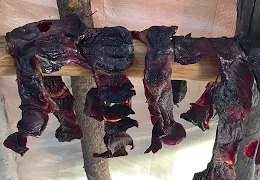
I had no qualms that they would be able to bring it although it would be a heavy load. This was the very first time I had killed a moose but I already knew how to butcher it so I did not have to ask anyone to advise me on how I should do it. I learned how to do this by observation, and this was the same with butchering a caribou and the bear. I knew fully well of doing this of all that I am saying. up to the time I killed my first moose. The moose was a fair size and was very good to eat. I had also seen how the moose, caribou and bear meat was dried for preservation. But, for this moose, there was not enough meat to dry it. The final scene is of a pair of antlers leaning up against the tongue of a sleigh and the side of a house.