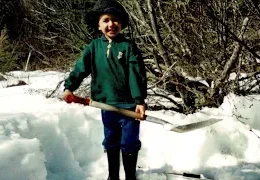
Standing by a snowbank, Abraham wears a bright orange safety/work jacket over a camo fleece, dark pants, and boots. His young grandson stands beside him in a white parka that has brown edging and caribou appliques on the pockets. His hands are in traditional fur-lined white mitts on a blue braided string. Abraham is going to give us a short lesson about melting snow for water when you are out in the bush or at camp in winter and can’t get water from solidly frozen streams and lakes.
He digs into the snowbank with a carved wooden snow shovel painted blue at the working end. The shovel makes a crunchy sound as it digs into the frozen snow. The boy watches, looking back at the camera from time to time.
Holding out some snow on the shovel, Abraham asks if we see what it looks like. Looks like sugar, he says. This kind of snow [that is crystallized], he explains, will produce plenty of water when you melt it.
Then he digs around in the snow lying close to the surface. He tells us that “This top layer does not make a lot of water when you melt it. It’s called ushaashui [the Cree word for new fresh, powdery snow on surface] and it does not produce much.”
Abraham digs around near surface again, shakes off most of the snow, and then picks some of it up in his fingers. It’s soft, he comments, it’s soft so the pail won’t have much water. Pail won’t have much when you want to fill it up with water from melting snow.