Videography: Chris Mullington, Valerie Gilpin, and Mary Holly Visitor
Speaker: George Natawapineskum
Translation: Luci Salt
Photos: Mary Holly Visitor and Katherine Scott
Safe Winter Travel with George Natawapineskum – Transcript
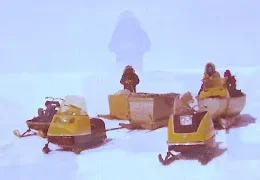
George begins the conversations with an eeyou greeting to all: “Waachiyaakw” and the camera pans over a group of three snowmobiles pulling sleds with passengers. We hear the wind, and snow is falling on this cold grey day. Dressed in a big navy parka with fur-lined hood, a snowmobile driver has his rifle slung over his shoulder just in front of us.
The camera pulls back so that we can see snowshoes in the sled he is pulling along with equipment and supplies well-wrapped in canvas tarp. George begins to explain that he will present some precautions that should be taken while traveling in winter: “I was advised to always take an extra set of clothing even if I was only planning to go a short distance and for only a short while because unexpected things can happen. This was in case I happened to have a mishap like an accident, falling in water, going through the ice, or getting stuck in wet snow conditions. This is where you can get wet and will need dry clothing”. The camera pans over some of the items one should carry such as extra socks, mitt and a hat, as well as matches and an axe.
George continues, saying that he was also told to always take some food even if he only planned to go a short way in the winter. The scene shifts to travelers sitting in the snow around a campfire with open lunch bags and thermoses beside them. A warmly dressed woman looks up at the camera as she sits on the other side of the fire watching a tea pail hung to boil over the fire.
The camera switches back to George sitting in the Heritage Language Projects office as he speaks. He’s got a New York Yankees cap on and a black hoodie with Wemindji ‘s 65th anniversary logo. Behind him we see the lower corner of a Cree syllabics chart; beside him a desk and a poster illustrating the Cree words for colours with a rainbow and brightly coloured geese.
Another piece of advice I was given, George continues, was not to go out if the weather was bad. “One thing that can happen is that you lose the trail and become lost during mid-winter. I always followed the trails made by others, especially if I went out for the first time after freeze-up. I just stayed on these trails. There are places where water doesn’t freeze and is therefore not safe for travel, I try to avoid these areas.”
“In mid-winter, I stay away from the areas where the ice never hardens enough to be safe to travel on. I stick to the trails where I it is safe and keep in mind the spots where the ice takes longer to melt in the spring. And then in the late fall and early winter I when travelling, I try to keep this in mind, the places where the ice becomes stronger than other areas.”
“When traveling in early winter and early spring the protocol of not venturing out alone was encouraged. We always travel together while hunting in the spring and we hitch a canoe to our snowmachine when we go out. Once I witnessed someone falling through the ice and the canoe was the thing that saved him.’
“The ice melts much faster in the spring now. Today the ice seems to be less sturdy than it was in the past during springtime.”
The scene changes to a frigid winter’s day on the ice, we hear the wind blowing and see snow falling – sky and snow-blanketed ice are matching shade of white-grey.
George concludes the session saying: “So, it is a good ideal to bring an extra set of clothing. Another essential item that should always be taken on these trips in the spring is rope. Having a rope can be very useful in helping someone get to safety, someone who has fallen through the ice.”
“Aakutaah. Waachiyaakw. [Okay, ‘bye for now, everyone]”