Vidéographie : Chris Mullington
Photos : Lindy Georgekish et Katherine Dehm
Récit : Sam Visitor
Enregistré par : James Bay Cree Communications Society
Traduction : Luci Salt
It is dawn on a fall day, the sun shining through dark spruces as it rises. We scan the forest and a bog, looking for moose as Sam Visitor tells the story of his first moose hunt. Few moose were seen in Wemindji territory thirty or forty years ago when he was hunting. He tells us, however, I already knew how harvesting a moose was done. At the time when I lead this hunt, I had four sons who already knew how to hunt. I went with two of them and another man, so there were four of us who went to hunt for the moose. I told my oldest son to head in a certain direction and to walk around in that area. Not long after, he headed back. The first animals we encountered were rabbits as they were plentiful at that time. He told us he did not see anything. I told him the moose must be in a certain location, and we started heading that way.
The camera pans past a small pond. Mist is rising from its surface; there is no wind. The landscape changes as we travel. By the water’s edge are rocks and few dead trees. Sam tells us that he walked through a bushy area and came out in a clearing where he spied something dark moving among the bushes. I was sure that it was a moose, he says, but I had no idea what direction he faced: whether he was standing sideways or facing this way, but I fired my gun in that direction anyway. As we move slowly and peer between some branches, a moose comes into view amongst the trees – spruces, bushes and tamaracks with yellow needles. The moose has a large and spreading rack of antlers.
Sam nous explique que « quand j’ai tiré mon fusil, j’ai vu l’animal bouger brusquement, comme s’il avait été surpris. J’ai pensé tirer une deuxième fois. Au moment où j’allais appuyer sur la détente, je l’ai vu tomber au sol. J’étais alors certain que c’était un orignal et je me suis dirigé vers l’endroit où il se trouvait. Mes fils étaient avec moi et nous avons tous vu l’orignal étendu au sol. Je leur ai dit de regarder où la balle l’avait frappé, comme on le fait toujours lorsqu’un orignal ou un caribou est abattu, afin de voir d’où vient le sang.
I knew that it had been standing facing in the opposite direction from where I shot it. My sons looked for the bullet hole but told me they did not see one. I looked at the way it had been standing when I shot it, but I also did not see the bullet hole either. I could tell that the moose had been facing the other way from where I had shot it. The moose we see here is facing away from us. I then noticed the bullet had gone in very close to the hole of its anus. It had gone through its body, hit the shoulder and this was where the bullet was embedded so I knew it would not make a hole in the skin. I told them that we should start butchering it right away, I had no problem in knowing how to do this because I had watched others butchering animals before. We finished in no time.
The scene fades to a moose lying in the shrubby undergrowth. It has been skinned, the first step for a hunter in cleaning a moose to bring it home. The legs of two hunters are just visible behind moose’s head and antlers.
Sam raconte qu’il leur a demandé de le découper d’une telle façon que ce soit facile de le placer sur un toboggan pour le ramener au camp. Je leur ai dit que nous ne le rapporterions pas à la maison ce jour-là, mais que nous reviendrions le lendemain pour le transporter jusqu’à notre camp. Alors, nous sommes retournés au camp, que nous avons regagné avant la tombée de la nuit. Le lendemain matin, mes fils sont retournés chercher l’orignal que nous avions déjà dépecé.
In the last scene we see the wooden sled piled with cut up meat, both small pieces and larger, lying on a black tarp in the sled. Antlers fill the left-hand side of the frame. They are grooved, rather than smooth, and shades of brown from dark to rust to beige.
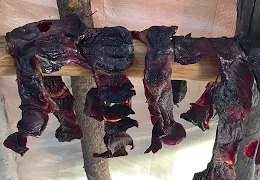
Je n’avais aucun doute qu’ils seraient capables de le rapporter, même si c’était une lourde charge. C’était la toute première fois que j’abattais un orignal, mais je savais déjà comment le dépecer, alors je n’ai pas eu besoin de demander conseil à qui que ce soit sur la façon de faire. J’ai appris à faire cela par observation, et c’était la même chose pour le dépeçage du caribou et de l’ours. Je savais très bien faire tout cela, tout ce que je raconte ici, avant même d’abattre mon premier orignal. L’orignal était de taille et très bon à manger. J’avais aussi vu comment faire sécher la viande d’orignal, de caribou et d’ours pour la conserver. Mais, pour cet orignal, il n’y avait pas assez de viande pour la faire sécher. La dernière scène montre un panache appuyé contre la flèche d’un traîneau et le côté d’une maison.